Below-knee prosthetics designed for affordability, adjustability & lifelong service.
Supported by IIT Gandhinagar, building modular prosthetic ankle systems that work for a lifetime.
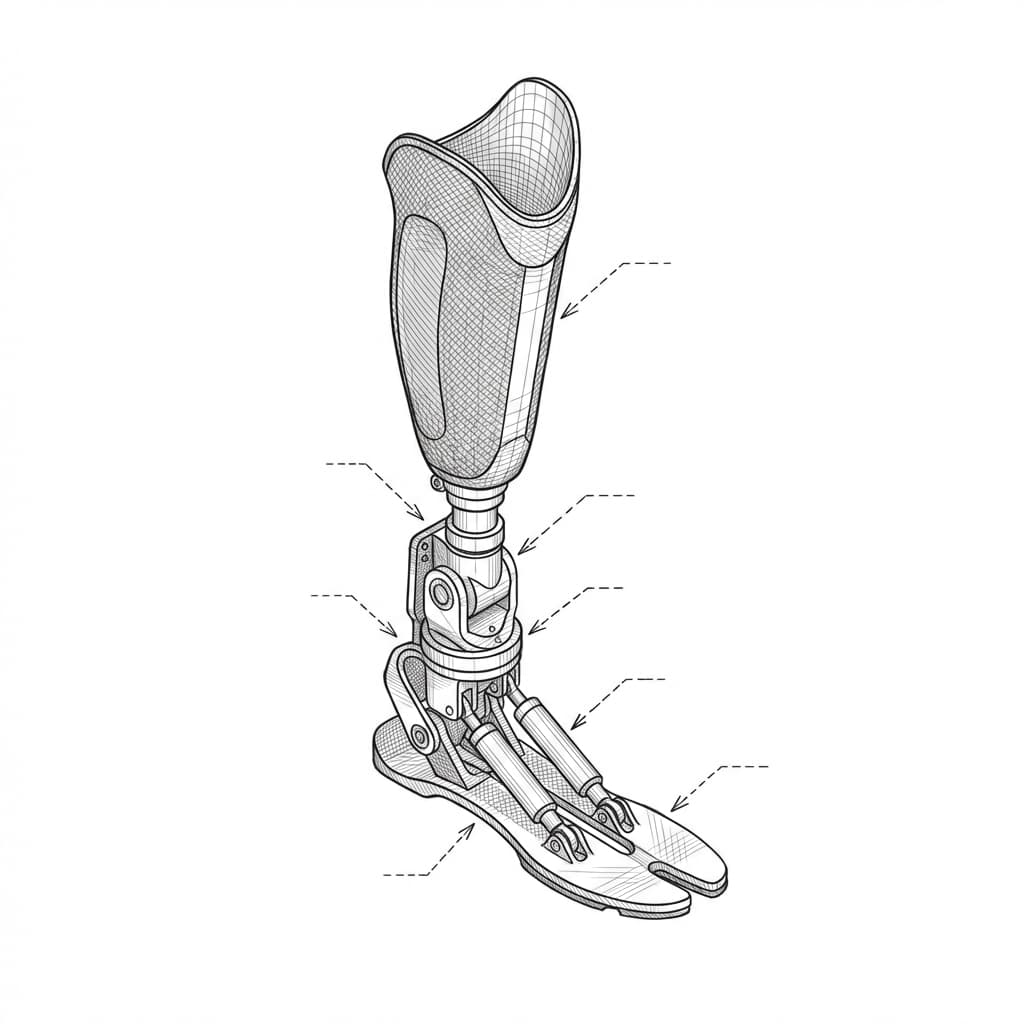
TRANSTIBIAL SYSTEM V2.1
Accessibility
High cost puts prosthetics out of reach for most people who need them.
Adaptability
Fixed designs fail to accommodate changing needs over time.
Serviceability
Repairs are expensive or simply unavailable in most regions.
Modular prosthetic technology that adapts to life.
Our modular ankle attachment integrates with existing prosthetic systems, enabling controlled articulation and improved adaptability during walking.
Engineered for adjustment, repair, and replacement — without swapping the full device.
Modular Design
Install, replace, or upgrade individual components — no need to replace the entire device.
Retrofit Compatible
Integrates with prosthetic components already used in clinical practice.
Mechanically Intelligent
Purely mechanical — durable, low-cost, and serviceable over a lifetime.
Process Flow
User needs & constraints
We begin by analyzing requirements and real-world usage patterns to inform the design.
Engineering & design
Precise structural and mechanical design using CAD, FEA simulation, and material science.
Prototyping
Functional prototypes via additive manufacturing to evaluate fit, form, and mechanics.
Testing & iteration
Rigorous lab testing and user feedback loops drive continuous refinement.
Long-term service planning
Modular maintenance protocols to keep devices functional and upgradeable over time.
Frequently asked questions
We develop a modular mechanical ankle attachment for passive transtibial (below-knee) prosthetic limbs. It is designed to improve adaptability during walking while remaining compatible with existing prosthetic systems.
Our ankle module is purely mechanical, modular, and retrofit-compatible. Unlike monolithic prosthetic designs, individual components can be adjusted, repaired, or replaced over time — without replacing the entire device. This makes it more affordable and serviceable long-term.
Our product is designed for individuals with transtibial (below-knee) amputations who use passive prosthetic limbs. It integrates with existing prosthetic components already in clinical use.
Not yet. We are currently in the prototype refinement and laboratory validation phase. User testing through prosthetic clinics and rehabilitation organizations is planned for the next stage.
We are based in Pune, India, with our research hosted at the Indian Institute of Technology Gandhinagar (IIT Gandhinagar).
We are supported by the Nidhi PRAYAS Grant from the Government of India, hosted at IIT Gandhinagar, and backed by Emergent Ventures.
Yes — we are currently looking for Mechanical Engineering Interns in Simulation & Analysis and Robotics & Mechanisms. Visit our Careers page for details and to apply.
We welcome partnerships with prosthetic clinics, rehabilitation organizations, research institutions, and service providers. Reach out to us at keyashah.work@gmail.com or visit our Contact page.